Dhamar: Public Works, Transportation, and Youth and Sports Offices Commemorate the Anniversary of the Martyr of the Quran
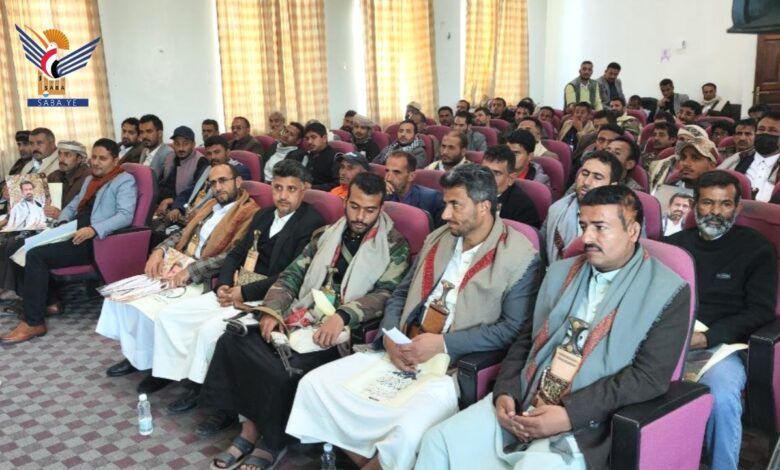
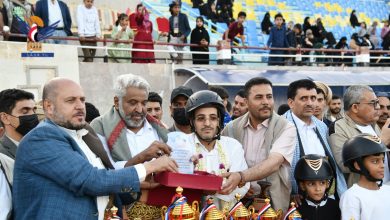
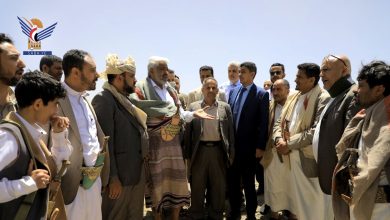
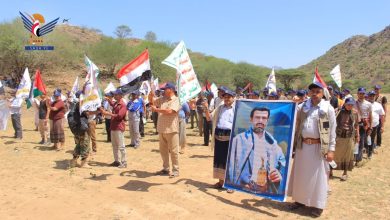
The Public Works Office, the General Authority for Regulating Land Transport Affairs, and the Youth and Sports Office in Dhamar Governorate organized a commemorative event today to mark the anniversary of the martyrdom of Sayyid Hussein Badr al-Din al-Houthi, the Martyr of the Quran.
During the event, Deputy Governor Mahmoud al-Jubain emphasized that commemorating the martyr of the Quran represents a renewed awareness, recalling an exceptional figure whose like is rarely seen. He pointed out that the martyr leader was not a fleeting event, but rather a pivotal turning point in the consciousness, thought, and trajectory of the nation.
He explained that speaking about the martyr leader is speaking about a comprehensive project of awareness and a genuine intellectual renaissance that stemmed from a conscious Quranic perspective. He carried the concerns of the nation, confronted challenges with courage, and re-examined the fundamental questions related to identity, responsibility, and revival. Al-Jubain pointed out that the martyred leader was distinguished by a profound understanding of the Quran, which led him to treat the Holy Quran as a way of life, a constitution of guidance, and a source of liberation and development. He noted that the leader realized that the fundamental flaw in the nation’s reality did not lie in a lack of capabilities or resources, but rather in the absence of awareness, the loss of direction, and the distancing from the Quran as a living reference that governs stances and behavior.
For his part, Taysir Rawiya, Director of the Youth and Sports Office in the governorate, affirmed that the intellectual revolution led by the martyred leader was a revolution against intellectual surrender, cultural subservience, and the reduction of religion to rituals isolated from the realities of life.
He emphasized that the leader redefined fundamental concepts in the life of the nation, most notably that faith is a stance and a responsibility, that guidance is the greatest blessing, that true gratitude is expressed through action, and that the nation’s dignity can only be preserved through awareness and independence. He explained that the purity of the Quranic project and its distance from sectarian and regional projects made it a project for the entire nation, based on building the conscious human being, protecting society from intellectual and cultural invasion, and linking the Quran to people’s issues, concerns, and their political and social reality.
Rawiya pointed out that one of the greatest achievements of the martyr of the Quran was breaking the silence, raising long-postponed questions, confronting attempts to distort awareness, and establishing the conviction that the most dangerous defeat is internal defeat, that remaining silent in the face of injustice is a deviation, and that intellectual independence is a fundamental condition for any true renaissance.
At the event, which was attended by the directors of the Public Works Office, Engineer Mu’adh al-Shawkani, the General Authority for Water Resources and Facilities branch, Engineer Haitham Alloun, and the Sports City, Muhammad al-Awsh, the Deputy Director of the Public Works Office, Engineer Muhammad Rida, considered the anniversary of the martyrdom of the Quran’s companion, the martyr leader Sayyid Hussein Badr al-Din al-Houthi, a renewed milestone of faith and patriotism, recalling the values of sacrifice and struggle, and embodying the meanings of honor, dignity, and Quranic awareness.
He explained that the martyred leader was a martyr of the Quran and truth, a man of Muhammadan generosity and Husseini patience, a symbol of steadfastness in a time of silence, and of glory in a time of humiliation.
He pointed out that the leader revived the meanings of pride and dignity in people’s hearts, eradicated the culture of humiliation and subservience, and taught the free people of the world how to confront injustice, shake the thrones of tyrants, and reject the hegemony of invaders and oppressors.
For his part, Ahmed Hamed, Deputy Director of the General Authority for Regulating Land Transport Affairs, affirmed that commemorating the martyrdom of the leader, Sayyid Hussein Badr al-Din al-Houthi, represents a renewed awareness that recalls the greatness of a Quranic project that restored the nation’s compass, awakened its consciences, and solidified the meanings of pride and dignity.
He clarified that speaking about the martyred leader is not limited to a person, but rather it is speaking about a resounding cry that shook the conscience of the nation and clearly directed the compass of the struggle towards the enemies of God and the enemies of the nation, foremost among them America and the Zionist entity.
Hamed pointed out that the martyred leader left the nation not mere words or slogans, but a living, Quranic project that transforms faith into action, thought into active awareness, and steadfastness into an enduring, unwavering victory.
The event included a moving poem by Saleh al-Jufi, head of the Union of Poets and Singers, and a choral performance by the Ashbal al-Masirah group.