Imam Zayd: The Renewed Flame of Revolution in the Memory of Yemenis and the Nation’s Fronts
Report: Jamil Al-Qashm
The anniversary of the martyrdom of Imam Zayd ibn Ali, peace be upon them, stands out as a turning point in the nation’s revolutionary consciousness. Its presence is renewed every year in the conscience of the free as a symbol of dignity and a banner of resistance against tyranny.
This anniversary is also evident among the Yemeni people as an expression of the natural extension of a jihadist identity deeply rooted in their history and culture.
At the nation’s current moment, as the confrontation with the enemies of religion and Arabism intensifies in more than one arena, this anniversary takes on additional dimensions that go beyond mourning to a fervent mobilization. The presence of Imam Zayd has almost become a term in the consciousness of the cultural front, an intellectual beacon that illuminates the free peoples seeking dignity and liberation from the grip of subjugation.
The memory of his martyrdom is present in the Yemeni consciousness like a compass that regains its position whenever the forces of arrogance attempt to shake the people’s awareness. With every act of aggression and every regional or international conspiracy, this people’s behavior is renewed.
The model set by Imam Zayd in refusing to remain silent, speaking out for the truth, and striving for the sake of God is reflected today in their honorable jihadi stance in support of Gaza and in confronting the Zionist assault on the nation.
Imam Zayd’s revolution, peace be upon him, embodied the features of an authentic revolutionary school. It did not seek power or pursue authority, but rather responded to God’s command to confront falsehood and defend the oppressed. This is the same spirit that Yemenis carry today as they take to the streets, embracing the principles of the revolution in support of Palestine, just as Imam Zayd did.
Anyone who contemplates the Quranic approach followed by Imam Zayd, peace be upon him, will find it manifest in the vision of the martyred leader, Sayyid Hussein Badr al-Din al-Houthi, who re-read Islamic history from the perspective of awareness and insight. He devoted considerable time to Imam Zayd’s revolution, describing it as a moment of exposure of the corrupt Umayyad reality and a milestone that must be re-examined to build the nation’s awareness of its true enemies in this era.
The biography of Imam Zayd occupied a significant space in the Quranic lectures delivered by the martyred leader, who presented him as a figure who combined jurisprudence and jihad, knowledge and action, and as a living example that those who remain silent about injustice are complicit in it, and that the nation cannot rise unless it makes its martyrs unforgettable beacons in its cultural literature and political behavior.
The leader of the revolution, Sayyid Abdul-Malik Badr al-Din al-Houthi, is also keen to ensure that this anniversary does not pass without invoking it in his speeches. He emphasizes that the steadfastness and sacrifices Yemen is experiencing today are a natural extension of Imam Zayd’s legacy and a practical embodiment of his immortal slogan, “No people hate the free swords except that they are humiliated.” This slogan epitomizes the philosophy of dignity and rejection that constitutes the identity of the contemporary Quranic project.
In the consciousness of the Yemeni Cultural Front, this anniversary represents a moment of revival and renewal, in which the values of renaissance and sacrifice are revived and historical events are linked to the present of confrontation.
The biography of Imam Zayd is not read as a chapter from the past, but rather as an extended banner, a voice crying out from amidst his blood to propel the nation toward liberation and confront arrogance in all its forms and manifestations. This renewed revolutionary memory has yielded a collective awareness among the Yemeni people.
Occasions associated with martyrs and leaders have become moments of mobilization and rallying, embodying the connection between the past and the present.
Imam Zayd has transformed from a page in a book into a spirit in the trenches, a voice in marches, a footstep on the front lines, and an echo replayed in every speech and every stand of pride and dignity.
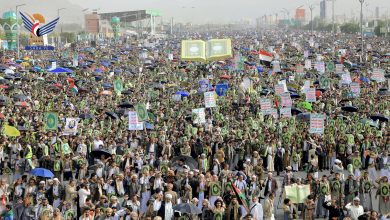
This vivid awareness was evident in the interaction of millions of Yemenis with the events taking place across the various governorates, where slogans of loyalty to Imam Zayd’s approach were raised, and his revolutionary words echoed in chants. This popular movement coincided with a parallel mobilization and awareness campaign in the media, pulpits, and lectures, making this anniversary a true union of emotion and knowledge, history and reality.
This year’s commemoration of Imam Zayd’s martyrdom was tinged with the spirit of the Yemeni stance in support of Gaza, as if history were repeating itself more clearly. Yesterday’s enemy is today’s enemy, and yesterday’s uprising against Umayyad tyranny is now met with a more advanced stance against the Zionist entity.
The revolutionary lines are the same, regardless of time and place, as long as the essence of the battle is truth against falsehood.
This commemoration comes at a historic moment when Palestine is witnessing the most heinous aggression, while most Arabs stand as spectators. Vivid stances emerge from the heart of Sana’a and all Yemeni cities, resembling those first outcries in Karbala and Kufa.
There is no room for complacency, no choice but jihad, and no voice is louder than the voice of the righteous stance, which asserts itself through action, stance, and word.
Imam Zayd’s lessons are evident today in the vocabulary of confrontation, in the tools of mobilization, and in the approaches to revolutionary discourse, which is not subject to reality but engages with it, directs it toward truth, and reformulates the relationship between religion and politics based on the Quran and dignity, not on defeatism, justification, and submission to a reality imposed by force of arms and propaganda.
The true significance of commemorating this anniversary lies in the fact that it cannot be viewed in isolation from the liberation project led by Yemen today. Every act of loyalty to Imam Zayd contains, at its core, a condemnation of silence, an incitement to revolution, and a call to redefine religious values, free from subservience.
This is the message that Yemen now carries for all free people around the world, from its advanced position in the global battle against global tyranny.
This anniversary today is part of the living political memory of contemporary Yemen, as Imam Zayd has become a symbol of revolution, not sectarianism; of freedom, not history; of truth, not jurisprudential interpretations. In this sense, Imam Zayd has become one of the pillars of modern Yemeni cultural identity, as the historical equivalent of every act of liberation that confronts Zionist-American aggression, subservience, and hegemony over peoples.
Thus, the commemoration of Imam Zayd does not conclude with weeping over the past. Rather, it begins a project of awareness, opens windows of action, and transforms history into a driving force for confrontation. Through it, the image of Yemen is revealed as the martyrs intended: an unbreakable banner, an unsuppressed voice, and an unbothered stance. Imam Zayd remains, every year, a beacon of confrontation and an unquenchable flame in the long night of the nation.
Amid the daunting challenges facing the Yemeni people, from ongoing aggression and a blockade led by America, Saudi Arabia, and the UAE, the greatness of the Yemeni stance is evident in its failure to wallow in its wounds, but rather, it transcended its pain to shoulder the nation’s cause. Its presence in the battle for Palestine was sincere, stemming from faith, and a fervent stance, drawing its embers from the glow of Karbala, from the cry of Zayd, from the patience of Hussein, and from the greatness of the life of the Prophet’s family.
The revolutionary leadership in Sana’a has proven that adherence to Quranic values yields a stance that does not dissipate under siege, nor does it retreat in the face of aggression. Rather, it grows stronger and more steadfast, confirming to the world that Yemen, though weakened by its wounds, is not broken. Its revolution is inseparable from the revolution of Hussein and Zayd, and supporting Gaza is a deeply rooted belief in the conscience of a people who do not compromise their dignity and do not shun the nation’s great battles.