Prime Minister Participates in Commemoration of Sayyid Badr al-Din al-Houthi
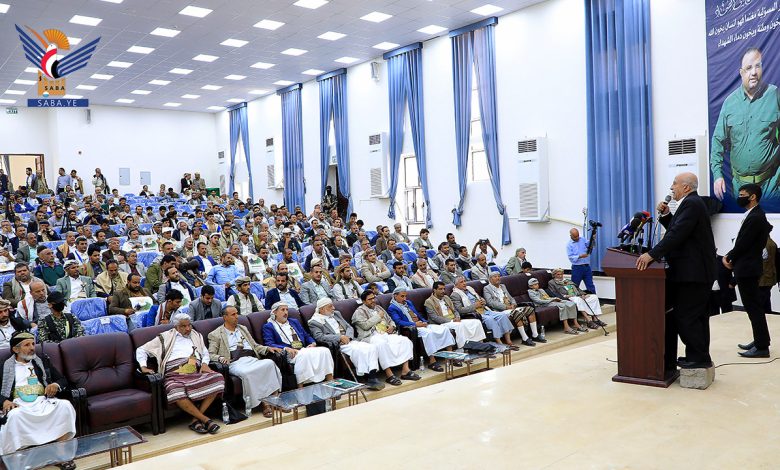
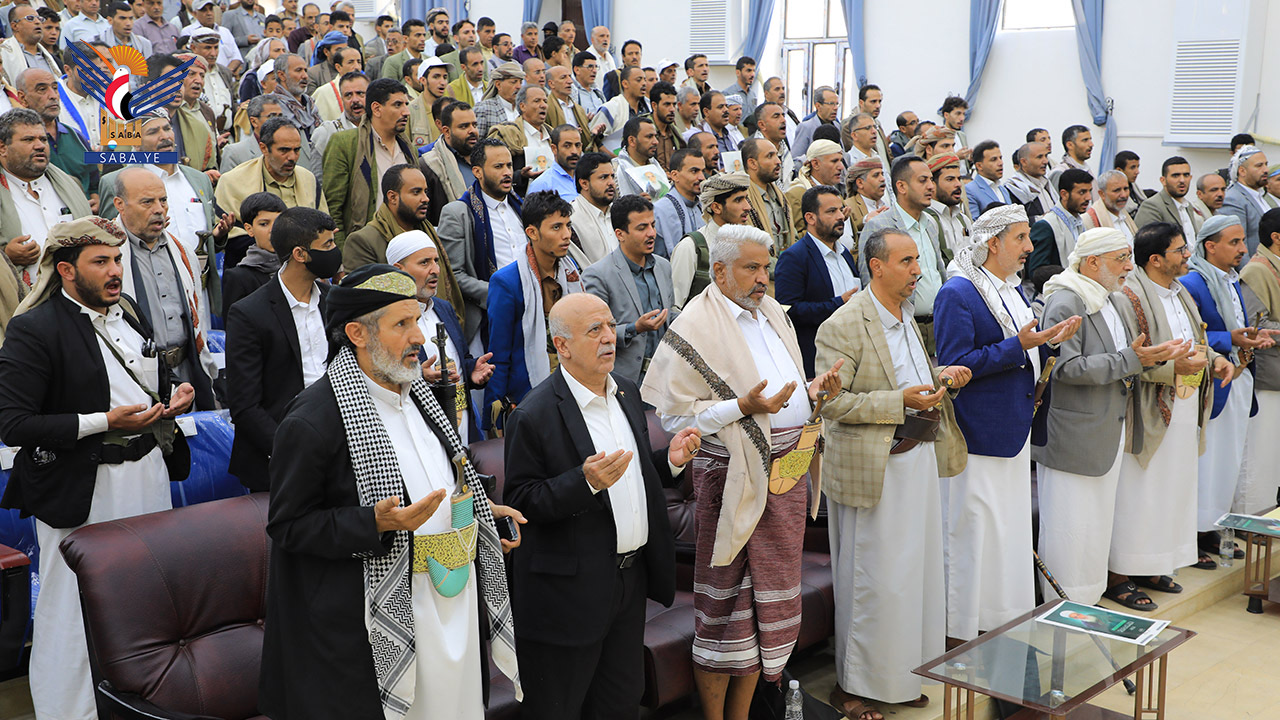
Prime Minister Ahmed Ghaleb al-Rahwi participated today in the commemoration of the passing of the divine scholar Sayyid Badr al-Din al-Houthi.
In his speech on the occasion, al-Rahwi emphasized the importance of commemorating the passing of this divine scholar and highlighting his religious, humanitarian, intellectual, and jihadi achievements and emulating them.
He pointed out that the deceased was a beacon of knowledge, and many eminent scholars and students studied under him, drawing from his pure fountainhead what benefited them and their nation. He highlighted the deceased’s approach to establishing proof against those who introduced into religion illicit rulings, seeking to mislead the nation into useless matters. He said, “Sayyid Badr al-Din al-Houthi’s primary concern was to please God Almighty, to extend a helping hand to the nation in all that is best for it, and to meet its needs for correct Islamic and jurisprudential knowledge.”
He added, “He was pious and devout in this world. His greatest concern was to raise people’s awareness and clarify the essence of religion for their benefit in this world and the hereafter, and to support and defend the truth.”
The Prime Minister addressed the latest developments in occupied Palestine, and in Gaza in particular, explaining that the injustice, daily massacres, genocide, and deprivation of food, water, and medicine to which the people of Gaza are subjected are a shameful image of this period, in which injustice and falsehood prevail over truth.
He considered the blatant aggression taking place today against the Islamic Republic of Iran to be part of the efforts of the Zionist cancerous tumor and the foreign entity in the region to extend its hegemony over the entire region with arrogance and conceit, with the support of Western and American imperialism.
Al-Rahwi described the Zionist aggression against Iran as blatant and unjustified, stressing that the sisterly Republic of Iran possesses the strength and cultural and human depth that qualifies it to defeat the bastard entity planted by the West in the heart of the nation to harm its entire body and sow discord and division among its people.
He said, “For the first time, we are seeing this devastation and destruction of vital Zionist facilities as a result of the missiles and drones launched by the Iranian armed forces, and greater things are coming, God willing.”
The Prime Minister called on everyone to follow in the footsteps of Sheikh Badr al-Din in confronting falsehood, defending truth, and eliminating injustice. At the event, attended by Deputy Speaker of the Shura Council, Dhaif Allah Rassam; Ministers of Transport and Public Works, Mohammed Qahim; Oil and Minerals, Dr. Abdullah Al-Amir; Culture and Tourism, Dr. Ali Al-Yafei; and a number of members of the House of Representatives and the Shura Council, the scholar Fuad Naji, a member of the Yemeni Scholars Association, emphasized that Sheikh Badr al-Din was an exceptional figure who acted in a time of silence, stood firm in times of inaction, and shone forth with truth in a time of fear. He acted at a time when tyrants sought to silence voices and extinguish God’s light with their mouths.
He pointed out the importance of commemorating the anniversary of the deceased’s passing to learn about his life and biography, as a model of an ascetic scholar and a zealous fighter for his nation. He noted that the deceased offered a constellation of his children for the sake of God and in support of truth. He was a humble, pious, and devout scholar. He reviewed the virtues and qualities of Sheikh Badr al-Din al-Houthi and his role in reviving Islamic sciences, clarifying religious concepts, and confronting misleading ideas.
He also reviewed his role in the Quranic movement, keeping pace with it, and his good upbringing of his sons, who inherited from him knowledge, righteousness, courage, speaking the truth, and supporting the oppressed.
Scholar Naji noted that the deceased was a proof, a role model, and a role model. He was one of the divine scholars who carried knowledge and embodied it in reality and action. He explained that the late Badr al-Din al-Houthi embodied the lives of his forefathers, the noble family of the Prophet, and combined knowledge with jihad.
He stated that the deceased was a leader and hero of the battle of awareness, as evidenced by his writings, which filled Yemeni libraries and numbered more than 40, most notably “Interpretation of the Quran,” “The Liberation of Ideas,” and “Breathability in Response to the Fatwas of the Hijaz,” among other works. He explained that the late scholar would respond to takfiri scholars, establish evidence, and fear no one for the sake of God. He was also distinguished by the jihadi spirit that animated him during that period, roaming deserts, traveling to different countries, and visiting villages. He was a social reformer and religious guide who was keen to instill the jihadi spirit in his students and children.
Cultural activist Yahya Abu Awada reviewed aspects of the late scholar Badr al-Din al-Houthi’s career and his well-known roles in combating alien ideas and false cultures, and in opposing takfiri projects that incite sedition and hatred.
He emphasized that he had demonstrated humanitarian stances throughout his life as a scholar, ascetic, and religious man, enriching the Yemeni library with numerous religious and reference books and publications.
He also highlighted his approach to life, which included courageous stances in affirming the meanings of freedom, integrity, and justice.
Abu Awada, a student of Badr al-Din, spoke about the spiritual aspects that characterized the deceased as a scholar whose role was not limited to a specific, limited aspect, but rather was a researcher and scrutinizer of religious concepts and issues of faith that touched upon society’s need to enlighten it with correct knowledge and understanding.
He highlighted his unique methodology in delivering lessons and lectures, communicating truths, and refuting the false cultures that distorted religious curricula. He explained that he was pious and came from a humble family, and was keen to convey his knowledge to society.
The commemoration of his passing was considered a moment to draw lessons and morals from his fragrant life, his knowledge, patience, and asceticism, and to follow the path of Muhammad, the Prophet’s family, and the beacons of guidance. He reviewed the role of the deceased and his actions, based on the responsibility placed on scholars and preachers to enjoin good and forbid evil, speak the truth, and combat corruption, injustice, and oppression.
The event, which was attended by a number of deputy ministers, undersecretaries, and social figures, included a poem by Badi’ al-Zaman al-Sultan, expressing the qualities, morals, and virtues of the late scholar Badr al-Din al-Houthi.