Red Sea Ports: A Lifeline That Defies Difficulties and Continues to Give
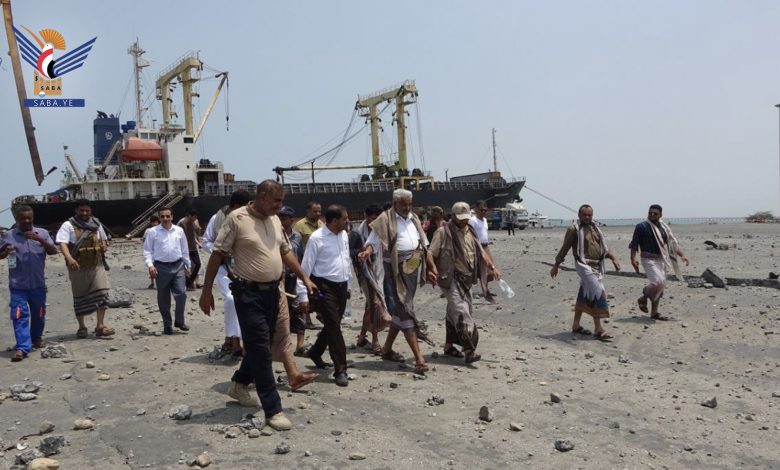
The Red Sea ports, foremost among them the port of Hodeidah, are one of the most important pillars of economic and humanitarian resilience in Yemen. They have proven their worth and ability to continue operating despite the recent direct Zionist and American attacks that inflicted significant damage to their vital infrastructure.
Despite the enormous challenges, the Red Sea ports have continued to operate at a high level of efficiency, ensuring the flow of food, medicine, and petroleum products to millions of Yemenis across various governorates, amid the exceptional circumstances the country has been experiencing for years.
Field reports indicate that the movement of ships receiving and unloading has not stopped, but rather has continued at an organized pace, thanks to the ongoing efforts of technical and administrative personnel, in addition to the emergency measures taken to ensure the continuity of operations.
Minister of Transport and Public Works Mohammed Qahim emphasized that Hodeidah’s ports constitute an advanced economic front, and that their workers play a significant role in serving the Yemeni people. He praised their high patriotic spirit and ability to overcome challenges with unwavering determination.
He said, “Thanks to God and the efforts of our people, the port is providing its services with high efficiency, and work continues at an accelerating pace despite many obstacles.” He emphasized that the Ministry of Transport and Public Works attaches utmost importance to strengthening the ports’ capabilities and is working to provide the capabilities to improve their performance and sustain their services.
For his part, Hodeidah Governor Abdullah Atfi considered what is happening in Hodeidah’s ports to be an integrated economic battle, in which workers face all forms of challenges with a sincere patriotic spirit.
He pointed out that the local authorities are keen to support the efforts of this vital artery, which represents a safety valve for the flow of goods and products needed by the local market.
Governor Atfi explained that the remarkable steadfastness shown by the port’s workforce reflects a high level of awareness of responsibility and confirms that the people of Hodeidah have been and continue to be at the forefront of protecting the country’s resources and proving their presence in the battle for economic sovereignty. Continuous field visits by the Ministers of Transport and Oil, as well as the Governor, are not only intended to monitor the ports continuously. These visits have also become tools for implementation and close observation, addressing challenges from the field rather than from the office.
The Chairman of the Red Sea Ports Corporation, Zaid Al-Washli, indicated that work at the port is proceeding at a rapid pace around the clock, and that docking schedules and unloading programs have not been affected despite the damage. He noted that technical and engineering personnel began inventory and remediation work from the first moments.
He stated that technical teams succeeded in implementing immediate measures to ensure the continuity of operations without disruption, which has strengthened the confidence of port customers and contributed to maintaining its position as a vital reception center for essential goods.
The emergency action plan is being implemented at the ports of Hodeidah and Ras Isa, in parallel with the continued reception of ships, reflecting a state of discipline, commitment, and preparedness rarely seen in an operating environment under the pressure of repeated attacks. What reinforces the significance of this achievement is the continued normal berths of foreign commercial vessels at the two ports.
This reflects the growing confidence of international shipping companies in the Red Sea Ports Corporation’s ability to operate efficiently, despite the challenges it faces.
The importance of ports is not limited to commercial aspects; they also represent a national, economic, and humanitarian frontier. Their continued operation, despite harsh conditions, is a true embodiment of the resilience and determination of the Yemeni people.
Despite the direct targeting of docks and equipment in a flagrant violation of international law, the scene on the ground reflects a national will that has transformed the damage into an opportunity for progress and construction, not a state of stagnation or collapse.
In this context, the competent authorities are working to document the violations suffered by the ports, in parallel with the preparation of strategic plans to enhance their operational capabilities and expand their capacity, particularly at Ras Isa Port, in anticipation of any emergency that threatens global supply lines.
Red Sea ports play a crucial humanitarian role, as they are the sole outlet for the entry of goods and essential materials into Yemen, giving every achievement there both a national and humanitarian dimension.
If the ports have withstood aggression and targeting, the secret of this resilience lies not in concrete or equipment, but in the human workers on the ground, who work day and night to keep this artery open.
What is happening today in the Red Sea ports is a clear message to the world that, despite the wounds, Yemen is still capable of protecting its vital waterways, defending its sovereignty, and meeting the needs of its people with all its will and steadfastness.