The Council of Ministers approves the plan to commemorate the Prophet’s birthday and the organizational regulations for four ministries
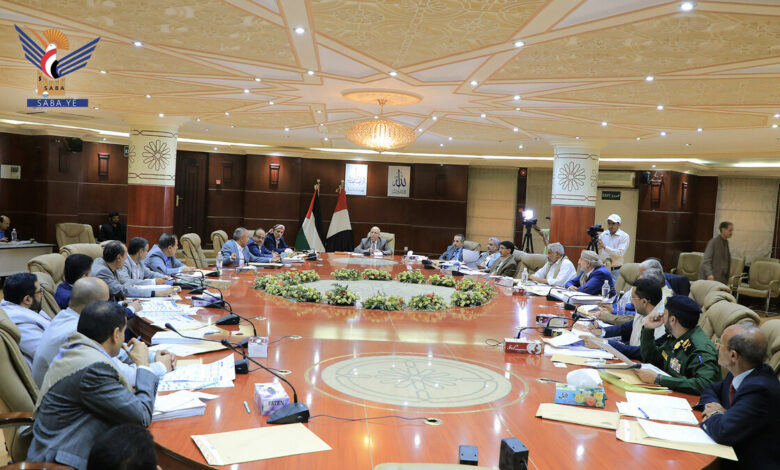
In its meeting today, chaired by Council Chairman Ahmed Ghaleb Al-Rahwi, the Council of Ministers approved the draft plan of the Government of Change and Construction to commemorate the Prophet’s birthday, may the best prayers and peace be upon him and his family, for the year 1447 AH.
The plan includes the tasks assigned to various central and local public service units to celebrate this blessed occasion, including the celebratory religious and cultural events and activities that will be held over the coming weeks until the 12th of Rabi’ al-Awwal.
The Council emphasized the importance of celebrating the birth of the best of creation and the Seal of the Prophets, whose honorable birth represents an annual religious milestone to strengthen the faith identity of our Yemeni people, their close connection to their noble Prophet, and their adherence to his righteous prophetic guidance.
He emphasized the importance of the active participation of all leaders in commemorating the occasion and sharing with citizens in the capital, governorates, and districts their celebration of the Prophet’s birthday. He directed all ministries and their affiliated agencies to form mobilization committees for the central celebration, which will be held on the twelfth of Rabi’ al-Awwal.
The Council tasked the Prime Minister’s Office with preparing the schedule for events held in ministries, agencies, and departments, to ensure proper organization and adherence to scheduled events.
The plan included a set of general guidelines for celebrating the occasion by all public service units, including charitable activities, social solidarity, and cleanliness; caring for the families of martyrs, the wounded, and those stationed there; caring for the poor, the needy, and the displaced; and visiting orphanages and the poorest families. It also aimed to strengthen the connection to the Noble Messenger, his spirit, and his life of jihad against infidels and hypocrites, considering jihad in his path the only and fundamental way to protect the nation, the integrity of its religion, and its dignity among nations.
The guidelines urge everyone to highlight the role of Yemenis with the Prophet, may God bless him and his family and grant them peace, in confronting the first ignorance and the ignorance of our time, and to expose the cultural trends that seek to separate the nation from the Prophet and the Holy Quran.
The Council emphasized the importance of honorable media coverage of this occasion and keeping abreast of all preparatory and accompanying activities and events held by the national media system, in a manner befitting its significance and place in the hearts of our free, noble, and honorable Muslim Yemeni people.
It commended the Ministry of Agriculture, Fisheries, and Water Resources’ initiative to plant trees in schools, neighborhoods, streets, parks, public places, and facilities, and to raise environmental awareness among society as part of the celebration of this great occasion, across the capital and governorates.
The Council extended its congratulations and blessings to Sayyid Abdulmalik Badr al-Din al-Houthi, His Excellency Field Marshal Mahdi al-Mashat, President of the Supreme Political Council, and all the people of the Arab and Islamic nations on the occasion of the anniversary of the Prophet’s birthday, asking God Almighty to bestow upon the people of Yemen and the Arab and Islamic nations goodness, blessings, and victory over the American, Israeli, and Western Zionists. He highlighted the religious and humanitarian significance of the Prophet’s birthday and its profound importance in light of the aggression, arrogance, and aggressive projects the nation is facing today that seek to strip it of its religion, its teachings, its identity, and its sound culture.
He pointed out that the jihadist methodology employed by the Yemeni people to confront their enemies over these years, and their support for their brothers in Gaza, is a practical embodiment of our people’s adherence to the prophetic guidance of the Final Messenger, his jihadist path, and his support for the oppressed.
During its meeting, the Cabinet approved draft regulations for the Ministries of Education and Scientific Research; Agriculture, Fisheries and Water Resources; Transport and Public Works; and Foreign Affairs and Expatriates.
This is in implementation of the mechanism for completing the integration and modernization of the organizational structures of public service units and its amendments. The Cabinet directed the relevant ministers to follow up on the legal procedures for their issuance.
The approved projects submitted by the Higher Committee for the Implementation of the Merger and Modernization of the Organizational Structures of Public Service Units reflect the leadership’s directives to develop the institutional performance of public service units, achieve their efficiency, and strengthen their role in implementing their assigned tasks and fulfilling their functional and service responsibilities in a manner that serves the path of change and development.
The draft organizational regulations for the Ministry of Education and Scientific Research consist of 71 articles divided into three chapters, including the name, definitions, objectives, tasks, and competencies; the organization of the ministry; and final provisions.
The draft organizational regulations for the Ministries of Agriculture, Fisheries and Water Resources consist of 62 articles; Transport and Public Works comprise 47 articles; and Foreign Affairs and Expatriates comprise 45 articles, each divided into four chapters: the name, definitions, objectives, tasks, and general competencies; the tasks of the ministry’s leadership; the organization of the ministry; and final provisions.
The Prime Minister said, “We dedicate this achievement, which coincides with our people’s approaching celebration of the Prophet’s birthday, to the Leader, who pays special attention to the process of building the state and developing its organizational structures.”
The Council listened to a brief presentation by the Minister of Civil Service and Administrative Development and Vice Chairman of the Supreme Committee for Merging and Modernizing the Organizational Structures of Public Service Units, Dr. Khaled Al-Hawali, on the procedural and technical steps adopted by the committee to accomplish this important national task in the process of building the state.
He explained that among the most important steps undertaken was the study and analysis of the objectives, tasks, and responsibilities stipulated in the presidential decrees defining the objectives, tasks, and main divisions of the four ministries to enable the implementation of subtasks, activities, and procedures necessary for their implementation.
He noted that the laws and executive regulations governing the work of the four ministries, particularly the laws subsequent to the issuance of the regulations, were studied and analyzed with the aim of identifying the tasks that need to be absorbed, abolished, or amended in light of the objectives and tasks stipulated in the presidential decrees for the four ministries.
Al-Hawali noted that the experiences of a number of comparative countries were reviewed, particularly those whose structures and regulations combined the various functions of these ministries.
They also reviewed a number of scientific references and studies related to the work of these ministries, as well as research related to shortcomings and deficiencies in their structures and work mechanisms.
He stated that, as part of the committee’s commitment to ensuring the role of stakeholders in this regard, field visits were conducted repeatedly to the ministries’ offices and meetings were held with senior and middle leaders to learn about the type and extent of the tasks they actually perform and the services they provide, as well as with the various units and facilities affiliated with them.
The Council expressed its thanks and appreciation to the Chairman and members of the Supreme Committee and the sectoral committees for the significant efforts and methodological approach adopted in preparing the draft regulations for these ministries.
It emphasized the great responsibility that rests on the shoulders of the leaders of the four ministries and all officials at various administrative levels in implementing the contents of the regulations after their issuance and translating this qualitative institutional structural transformation into practical reality.
He pointed out the importance of this organizational step in the context of establishing sound, clear, and rational institutional building.
The Council heard a report from Deputy Prime Minister for Defense and Security Affairs, Lieutenant General Jalal Al-Ruwaishan, on the latest developments in the confrontation with the American, Israeli, and British enemies, particularly their malicious plot to undermine Yemen’s military and popular support for our vulnerable brothers in the Gaza Strip in the face of the ongoing criminal, fascist Zionist aggression and siege, which has led to the martyrdom of thousands of them as a result of death traps, hunger, and thirst.
He explained that the enemy, after failing to compel our people through its direct criminal military aggression against Yemen, has resorted to spreading lies and misleading rumors that seek to undermine the internal front and distract Sana’a from its historical religious, moral, and humanitarian responsibility to support the people of Gaza.