Training Course on Heavy Equipment Operation and Maintenance Begins at the Roads Corporation Branch in Hodeidah
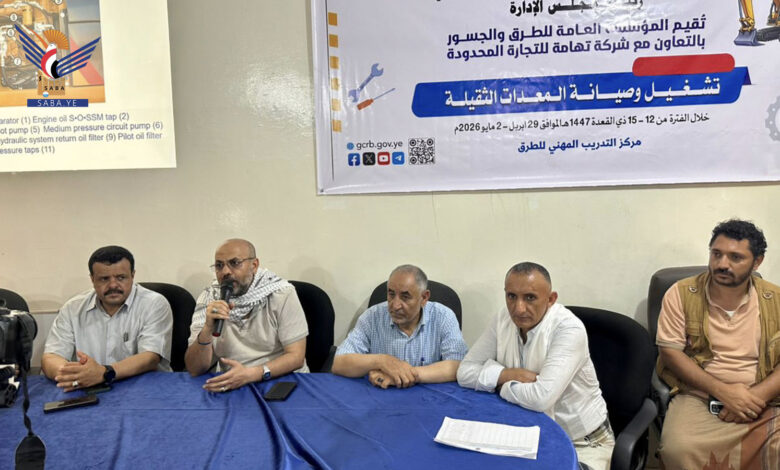
A training course on the operation and maintenance of heavy equipment began today at the Hodeidah branch of the General Authority for Roads and Bridges.
The four-day course, organized by the Authority’s Vocational Training Center for Roads, aims to enhance the efficiency of heavy equipment operators in safe operation and preventative maintenance. It will equip them with the essential knowledge and skills to maintain the equipment, minimize breakdowns, and improve operational performance.
At the opening of the course, the Chairman of the Board of Directors of the General Authority for Roads and Bridges, Engineer Abdulrahman Al-Hadrami, emphasized the importance of holding training courses at the center and branch levels, given their crucial role in maintaining the Authority’s heavy equipment.
He noted that training and qualifying heavy equipment operators contributes effectively to ensuring the continuity of work with high efficiency, reducing costs, and enhancing occupational safety. Al-Hadrami pointed out that the General Authority for Roads possesses a large fleet of vehicles and equipment and is keen to purchase more annually to keep pace with and complete the projects it undertakes in the fields of roads, bridges, and various infrastructure and construction projects in all governorates.
During the opening ceremony, attended by the directors of the Authority’s Hodeidah branch, Engineer Ibrahim Sharaf Al-Din, the mechanical engineer Hassan Mahdi, and the head of the National Vision Implementation Unit at the Authority, Engineer Bashir Al-Shami, the directors of the Central Workshop, Zaid Al-Mawari, and the Vocational Training Center for Roads, Engineer Mahmoud Ezz Al-Din, reviewed the objectives and topics of the course, both theoretical and practical.
They explained that the course focuses on the fundamental aspects of heavy equipment, primarily safe operation, introducing the types of equipment and their uses in road and bridge projects, as well as their components, functions, principles of correct operation, occupational safety rules, and common operating errors and their impact on the equipment’s lifespan. Al-Mawri and Ezz El-Din stated that the topics also include daily inspection, preventative maintenance, the concept of maintenance and its importance in improving equipment efficiency, checking oils, fluids, filters, tires, and chains, early fault detection through sensory observation (sound, vibration, temperature), the role of cleanliness and lubrication in prevention, common types of faults (mechanical, hydraulic, and electrical), their indicators, methods of identification and handling, and the driver’s role in minimizing the escalation of faults.
They also addressed the driver’s professional responsibilities, particularly in recording operating data and maintenance logs, optimizing fuel consumption and reducing waste, and extending the equipment’s lifespan through proper practices.