Road maintenance will cost more than 12 billion riyals in 2024
Yahya Jarallah
Maintenance of various types (periodic, routine, and emergency) has been and will remain the cornerstone of preserving the road and bridge network and ensuring its continued service to citizens. However, it has become a significant burden as a result of the ongoing aggression and blockade on Yemen for ten years, and the resulting serious economic repercussions that have significantly impacted the decline in road maintenance allocations. Road maintenance is one of the major and challenging tasks facing the state and government. The General Corporation for Roads and Bridges is responsible for implementing this task, along with the Road Maintenance Fund, which serves as a primary supporter and backer of its ongoing efforts to carry out emergency repairs to the road network. This is intended to preserve the road network and prevent it from reaching a stage where any repairs would be difficult to implement.
This would require rebuilding the road at a cost that cannot be met under the current circumstances, as the forces of aggression and their mercenaries continue to plunder the country’s wealth and resources, which previously contributed to covering the largest portion of the general budget.
The General Maintenance Department of the General Corporation for Roads is responsible for carrying out this vital task, which has faced numerous difficulties since the beginning of the aggression on Yemen and the resulting significant decline in the financial allocations previously allocated for periodic road maintenance, which contributes to extending their lifespan. In an interview with the Yemeni News Agency (Saba), the Chairman of the Board of Directors of the General Corporation for Roads and Bridges, Eng. Abdulrahman Al-Hadrami, explained that since 2015, public revenues have declined significantly as a result of the aggression and blockade, and with them, the funding allocated for periodic maintenance of roads has declined, which led to the aggravation of damage to them, which posed a real threat to the network and almost led to its total collapse, were it not for the great efforts made by the corporation, which continued to work to save the roads, especially the main ones, by laying thin asphalt layers as emergency solutions to limit the aggravation of the damage and to ensure that they remain in service.
The Foundation’s Chairman confirmed that, as a result of the decline in financial allocations for maintenance due to the aggression and blockade, the Foundation was forced to reduce the asphalt layers during maintenance, often to one centimeter, compared to five centimeters in previous periods.
This enabled the Foundation to address roughness on as many roads as possible, as an emergency solution lasting for approximately three to four years, thus preserving what could be preserved until conditions improve and sufficient allocations are restored to implement long-lasting asphalt layers. He noted that, due to the scarcity of financial resources allocated for maintenance, work was limited to routine and emergency maintenance, which was not feasible without periodic maintenance work. It was therefore necessary to seek alternative solutions and treatments, including the implementation of additional asphalt layers ranging from 2 centimeters to 5 millimeters, depending on the roughness of the road. This contributed to reducing the drain on funds allocated for recurring road maintenance. According to Engineer Al-Hadrami, the majority of roads have entered the rehabilitation phase, which requires significant funds that are difficult to secure under the current situation. However, the necessary and appropriate measures are being implemented to maintain them, based on available capabilities and resources, to ensure their continued readiness, the comfort of road users, and the reduction of accidents and vehicle wear and tear. He commended the attention paid by the revolutionary leadership, the President of the Supreme Political Council, and the government, represented by the Ministry of Transport and Public Works, to monitoring and supporting the efforts of the Foundation and the Fund to maintain roads, particularly the main ones linking the governorates.
Maintenance Work in 2024
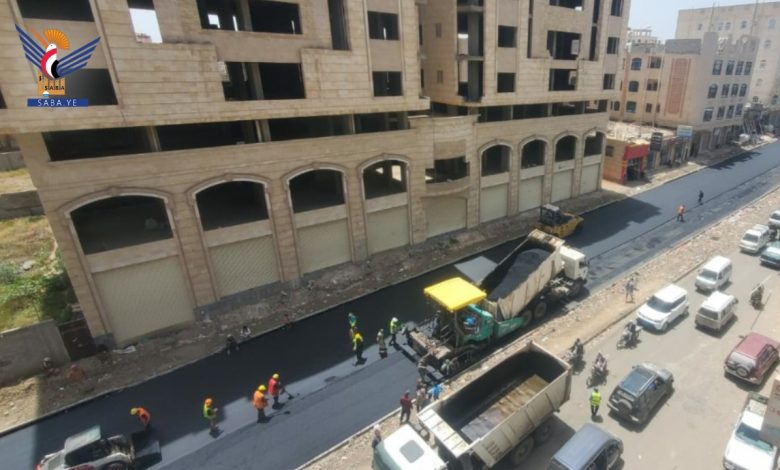
The past year, 2024, witnessed significant activity in road maintenance across all maintenance branches and centers. Asphalt repairs were carried out on the main road network, along with the cleaning of culverts and water drains on most roads.
In this regard, the Director of the General Administration of Maintenance at the Corporation, Engineer Abdul Qader Badi, explained that the total cost of road maintenance work during the past year amounted to 12 billion and 73 million riyals. He indicated that funding provided through the Road Maintenance Fund amounted to 11 billion and 666 million riyals, while the cost of work funded by the local authority in the capital, Sana’a, amounted to 224 million riyals, in addition to 147 million riyals from the local authority in Sana’a Governorate, and approximately 36 million riyals as a community contribution.
He stated that the asphalt mixture used in maintenance work during 2024 amounted to 60,128 tons, in addition to 4,480 tons of liquid asphalt. New Equipment Worth One Billion Riyals
The leadership of the General Authority for Roads and Bridges is keen to continue its program to purchase new equipment across its main general departments, including the General Administration of Maintenance, which represents the beating heart of the Authority, given its pivotal role in implementing maintenance projects and works that ensure road readiness and continuous traffic flow.
In this context, the Director General of Maintenance stated that his department was able to purchase new equipment worth more than 1.051 billion riyals last year. This equipment included two Cater 950 bulldozers, two double asphalt compactors, five Cater backhoe loaders, a Vogel 3-1800 asphalt spreader, an asphalt mixer, an asphalt cutting saw, another for tree trimming, four Phoenix cranes, a mobile caravan, two cement mixers, and five compressors. Equipment Repair
Engineer Badi confirmed that, in addition to carrying out road maintenance and repair work, the General Maintenance Department continued its equipment and crane repair programs at the Corporation’s branches and maintenance centers across the governorates.
These programs culminated in the repair of many of these pieces of equipment and machinery at a cost of 218.9 million riyals, while the cost of repairing the cranes amounted to approximately 40 million riyals.
Railways are defined as the locations or sites used by the Corporation as headquarters for its equipment and housing for its engineers and workers, in addition to carrying out administrative work for all branches and maintenance centers in the governorates.
As part of its plan for the current year, the General Maintenance Department seeks to carry out repair work on the cranes of the branches and maintenance centers at a cost of 80 million riyals. This is based on the importance of these cranes in developing and improving performance and accelerating the completion of various projects and projects implemented in various governorates. As part of the plan, the Maintenance Department also seeks to provide 500 tons of asphalt as a reserve stock, at a cost of 180 million riyals, as well as 300,000 liters of diesel at a value of 140 million riyals. It also seeks to purchase spare parts and tires for new equipment (buckets, Bobcats, dump trucks) at a value of 50 million riyals, and to repair equipment in branches and maintenance centers at a value of approximately 80 million riyals.